Popular on TelAve
- Advantage Marketing Launches 3-Minute Assessment to Help SMBs Diagnose and Fix Marketing Gaps - 104
- Card makers turn to Pink and Main for tools to support their craft
- Evermore Bliss Launches AI Wedding Speech Writer to Help Users Create Personalized, Heartfelt Toasts
- Mensa Brings National Board Game Competition to Northern Virginia April 16-19
- Special Alert! Highly Undervalued Stock: $317M Revenue in 2025 for Telecom Leader IQSTEL, Inc. (N A S D A Q: IQST)
- Acuvance Appoints Sandeep Sabharwal to Board of Directors, Strengthening Leadership to Support Continued Platform Growth
- Instant IP Launches Rapid Takedown Service to Combat IP Theft, Deepfakes, and Copycat Websites
- As Global Tensions Rise, Demand Grows for Private Spaces to Process Thoughts and Speak Freely Online
- Mac Mountain Selects netElastic vRouter for LightCraft Broadband-as-a-Service Platform
- Expert Law Attorneys' Top Law Firms to Know: March 2026
Similar on TelAve
- Viasat, Galaxy 1 Communications and L2 Aviation to bring avionics integration to Advanced Air Mobility
- $10 Million Annual Revenue Merger, Profitable Partner in AI Powered Specialty Automotive Sales Projected to Scale Above $200M: Stock Symbol: NWPG
- New Homesites Released at Heritage at Manalapan Featuring Scenic Golf Course Views
- Boston Industrial Solutions Launches Natron® 717S Series: A New Flexible UV LED Ink for Ricoh GH2220 Printheads
- Permian Museum Adds Carbonaceous Chondrite Reference Photos
- L2 Aviation Receives FAA STC and PMA for Klatt Works SAVED™ Smoke Vision System
- Project Pretzel Introduces a New System for Running Renovation Projects with Built In Contracts and Real Time Execution
- The Future of Classic Cars in a World Moving Beyond Gasoline: How Electric Conversion Is Saving America's Automotive Heritage
- L2 Aviation Acquires Advance Aero
- Igniting High-Growth Expansion as Electrification Strategy and Infrastructure Dominance Converge; 88% Revenue Growth (N Y S E: MWG)
FAA Confirms Structural Cracking in Airbus Cargo Doors — Validating Earlier Warnings by QA Expert and Boeing Shareholder Daryl Guberman
TelAve News/10895265
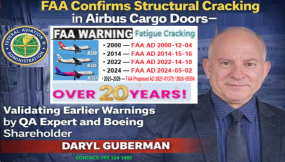
FAA Confirms Structural Cracking in Airbus Cargo Doors — Validating Earlier Warnings by QA Expert and Boeing Shareholder Daryl Guberman
BOSTON - TelAve -- FAA Confirms Structural Cracking in Airbus Cargo Doors — Validating Earlier Warnings by QA Expert and Boeing Shareholder Daryl Guberman
FAA's New Airworthiness Directive Confirms the Exact Structural Door Weakness Guberman Identified in Earlier Public Warnings
The Federal Aviation Administration has issued a new Notice of Proposed Rulemaking (NPRM) addressing structural cracking in the upper forward and aft corners of Airbus A320/A321 bulk cargo doors, confirming the exact type of fatigue‑related failure long identified by aerospace quality expert Daryl Guberman.
The proposed Airworthiness Directive (Federal Register Document No. 2026‑08594 (https://www.federalregister.gov/documents/2026/05/04/2026-08594/airworthiness-directives-airbus-sas-airplanes ) cites fatigue‑test findings showing cracks forming around fastener holes in the cargo‑door structure — a door assembly composed primarily of aluminum with localized reinforcement, consistent with Guberman's prior public analysis of door‑plug vulnerabilities across the industry.
Guberman previously published findings related to the January 5, 2024 Alaska Air door‑plug failure, identifying manufacturing performed in an uncertified environment and highlighting the systemic risks of weakened oversight across both Boeing and Airbus supply chains.
"This is precisely what I warned about — aluminum door structures under cyclic stress (on going vibration) will crack, and the regulators are now acknowledging it," said Guberman.
The $2 Trillion Paperwork Trap: Why 9,000 Planes Are Legally "Scrap"
https://youtu.be/sj9m7tqcBvA
The FAA's NPRM- mandates conditional repairs, and potential cold‑working (strengthening the metal by squeezing it) of fastener holes to restore structural integrity. The agency notes that unaddressed cracking could compromise the aircraft's structural safety envelope.
More on TelAve News
"This new FAA action validates the core issue: when certification systems fail, metal fatigue wins — and passengers pay the price," Guberman added.
Historical FAA Notifications Warning Airbus About Fastener‑Hole Fatigue Cracking (2000–2024)
The newly proposed 2026 directive is only the latest in a long chain of FAA warnings issued to Airbus over more than two decades. These directives repeatedly identified fatigue cracking around fastener holes, frame feet, and fuselage structural joints on A319/A320/A321 aircraft:
Airbus was warned in 2000, 2014, 2022, 2024, and now again in 2025–2026 about fatigue‑related cracking around drilled fastener holes.
SECTION: Boeing Oversight and Structural‑Integrity Implications
As part of this broader industry‑wide structural‑integrity discussion, Boeing must also be addressed. As a Boeing shareholder and long‑time quality professional, Daryl Guberman emphasizes that the FAA's newly proposed Airbus directive is not an isolated event — it is part of a systemic pattern across the entire aerospace sector where fatigue‑critical structures, drilled fastener holes, and aging airframes continue to reveal vulnerabilities. This includes heat treatment and welding which are flight critical processes.
Boeing has faced its own series of FAA actions over the past decade involving structural fastener‑hole cracking, manufacturing deviations, and quality‑system breakdowns, including:
More on TelAve News
The Accreditation Collapse Affecting Both Boeing & Airbus
https://www.prlog.org/13140232-the-accreditation-collapse-affecting-both-boeing-airbus.html
Guberman stated:
"Airbus is now facing the same physics Boeing faced — and still faces. When you drill holes into aluminum or composite structures and then subject them to vibration, pressurization, and cyclic:(on going vibration) loading, fatigue is inevitable unless oversight is airtight. Boeing's history shows what happens when oversight weakens. Airbus is now learning the same lesson." Guberman sent a warning letter to Airbus in September 11, 2025.
He added:
"As a Boeing shareholder, I expect Boeing to treat this Airbus directive as a mirror — not a shield. This is not the time for competitive relief. It is the time for structural honesty."
A comprehensive analysis showing how both Boeing and Airbus operated under a compromised accreditation chain, resulting in aircraft that cannot be retroactively re‑inspected or re‑certified. https://guberman-quality.com/wp-content/uploads/2026/04/ACCREDITATION-COLLAPSE-2002-PRESENT-BOEING-AIRBUS.pdf
Closing Statement
"I've said it before, and I'll say it again: when you drill a hole in a vibratory environment, you create a stress‑concentration point. Over time, cracks will form. This is predictable, preventable, and inspectable — but only if the industry takes these warnings seriously. For decades, especially when it came to Boeing, both Boeing and the FAA made the general public and government think that an airworthiness certificate superseded AS9100 — but they were wrong, "DEAD WRONG!"
Boeing & Airbus 9,000-Airframe Crisis 2018–2026 https://www.prlog.org/13137988-boeing-airbus-9000-airframe-crisis-20182026.html
"The world is rarely healed by institutions. It is healed by the one individual who sees the wound clearly enough — and cares deeply enough — to close it.
I have seen the wound.
I have mapped the fracture.
I am offering the repair."
— Daryl Guberman, 2026
"All who rise while burying the truth will one day be buried by it."
-Anonymous (proverbial wisdom)
"People don't reject the truth because it's wrong. They reject it because it demands change."
- ANONYMOUS
FAA's New Airworthiness Directive Confirms the Exact Structural Door Weakness Guberman Identified in Earlier Public Warnings
The Federal Aviation Administration has issued a new Notice of Proposed Rulemaking (NPRM) addressing structural cracking in the upper forward and aft corners of Airbus A320/A321 bulk cargo doors, confirming the exact type of fatigue‑related failure long identified by aerospace quality expert Daryl Guberman.
The proposed Airworthiness Directive (Federal Register Document No. 2026‑08594 (https://www.federalregister.gov/documents/2026/05/04/2026-08594/airworthiness-directives-airbus-sas-airplanes ) cites fatigue‑test findings showing cracks forming around fastener holes in the cargo‑door structure — a door assembly composed primarily of aluminum with localized reinforcement, consistent with Guberman's prior public analysis of door‑plug vulnerabilities across the industry.
Guberman previously published findings related to the January 5, 2024 Alaska Air door‑plug failure, identifying manufacturing performed in an uncertified environment and highlighting the systemic risks of weakened oversight across both Boeing and Airbus supply chains.
"This is precisely what I warned about — aluminum door structures under cyclic stress (on going vibration) will crack, and the regulators are now acknowledging it," said Guberman.
The $2 Trillion Paperwork Trap: Why 9,000 Planes Are Legally "Scrap"
https://youtu.be/sj9m7tqcBvA
The FAA's NPRM- mandates conditional repairs, and potential cold‑working (strengthening the metal by squeezing it) of fastener holes to restore structural integrity. The agency notes that unaddressed cracking could compromise the aircraft's structural safety envelope.
More on TelAve News
- SUMOFIBER Fuels Explosive Growth With netElastic vBNG
- NRx Pharmaceuticals (N A S D A Q: NRXP) Accelerates Into National Spotlight as Manufacturing Launch, Federal Policy & AI-Driven Breakthroughs Converge
- Expanding Into High-Margin Battery Recycling With Black Mass Strategy plus Scaling AI Infrastructure & Global Supply Chain Platform: N A S D A Q: MWYN
- Long-Distance Couples Spend Nearly $7,000 on Travel Before Moving In Together, New Mayflower Research Finds
- imggpt Launches AI-Powered GPT Image Generator and Photo Editor for Creative Teams
"This new FAA action validates the core issue: when certification systems fail, metal fatigue wins — and passengers pay the price," Guberman added.
Historical FAA Notifications Warning Airbus About Fastener‑Hole Fatigue Cracking (2000–2024)
The newly proposed 2026 directive is only the latest in a long chain of FAA warnings issued to Airbus over more than two decades. These directives repeatedly identified fatigue cracking around fastener holes, frame feet, and fuselage structural joints on A319/A320/A321 aircraft:
- 2000 — FAA AD 2000‑12‑04
- 2014 — FAA AD 2014‑15‑16
- 2022 — FAA AD 2022‑14‑10
- 2024 — FAA AD 2024‑05‑02
- 2025–2026 — FAA Proposed AD 2025‑01379 / 2026‑08594
Airbus was warned in 2000, 2014, 2022, 2024, and now again in 2025–2026 about fatigue‑related cracking around drilled fastener holes.
SECTION: Boeing Oversight and Structural‑Integrity Implications
As part of this broader industry‑wide structural‑integrity discussion, Boeing must also be addressed. As a Boeing shareholder and long‑time quality professional, Daryl Guberman emphasizes that the FAA's newly proposed Airbus directive is not an isolated event — it is part of a systemic pattern across the entire aerospace sector where fatigue‑critical structures, drilled fastener holes, and aging airframes continue to reveal vulnerabilities. This includes heat treatment and welding which are flight critical processes.
Boeing has faced its own series of FAA actions over the past decade involving structural fastener‑hole cracking, manufacturing deviations, and quality‑system breakdowns, including:
- 2019 — 737NG pickle‑fork cracking
- 2020–2021 — 787 fuselage join nonconformities
- 2024 — FAA oversight findings following the Alaska Airlines door‑plug separation
More on TelAve News
- Intuitive Flow Systems Launches Mokēd Meditation Whistle
- More Life Summit 2026 Announces Gary Brecka & Mr. Olympia Derek Lunsford as First Speakers for Miami Event
- Michael H. Kaplan, Colorado Workers' Compensation Attorney, Rallies Athlete Unions Against Proposed Legislative "Carve-Outs"
- Viasat, Galaxy 1 Communications and L2 Aviation to bring avionics integration to Advanced Air Mobility
- Fulton County DA Fani Willis Officially Endorses Dr. Heavenly Kimes + Black Economic Agenda
The Accreditation Collapse Affecting Both Boeing & Airbus
https://www.prlog.org/13140232-the-accreditation-collapse-affecting-both-boeing-airbus.html
Guberman stated:
"Airbus is now facing the same physics Boeing faced — and still faces. When you drill holes into aluminum or composite structures and then subject them to vibration, pressurization, and cyclic:(on going vibration) loading, fatigue is inevitable unless oversight is airtight. Boeing's history shows what happens when oversight weakens. Airbus is now learning the same lesson." Guberman sent a warning letter to Airbus in September 11, 2025.
He added:
"As a Boeing shareholder, I expect Boeing to treat this Airbus directive as a mirror — not a shield. This is not the time for competitive relief. It is the time for structural honesty."
A comprehensive analysis showing how both Boeing and Airbus operated under a compromised accreditation chain, resulting in aircraft that cannot be retroactively re‑inspected or re‑certified. https://guberman-quality.com/wp-content/uploads/2026/04/ACCREDITATION-COLLAPSE-2002-PRESENT-BOEING-AIRBUS.pdf
Closing Statement
"I've said it before, and I'll say it again: when you drill a hole in a vibratory environment, you create a stress‑concentration point. Over time, cracks will form. This is predictable, preventable, and inspectable — but only if the industry takes these warnings seriously. For decades, especially when it came to Boeing, both Boeing and the FAA made the general public and government think that an airworthiness certificate superseded AS9100 — but they were wrong, "DEAD WRONG!"
Boeing & Airbus 9,000-Airframe Crisis 2018–2026 https://www.prlog.org/13137988-boeing-airbus-9000-airframe-crisis-20182026.html
"The world is rarely healed by institutions. It is healed by the one individual who sees the wound clearly enough — and cares deeply enough — to close it.
I have seen the wound.
I have mapped the fracture.
I am offering the repair."
— Daryl Guberman, 2026
"All who rise while burying the truth will one day be buried by it."
-Anonymous (proverbial wisdom)
"People don't reject the truth because it's wrong. They reject it because it demands change."
- ANONYMOUS
Source: GUBERMAN-PMC,LLC
0 Comments
Latest on TelAve News
- RAS AP Consulting Launches Vendor Master File & Payment Controls Assessment for NACHA Phase 2 Compliance
- New Homesites Released at Heritage at Manalapan Featuring Scenic Golf Course Views
- The Ultimate Solution to Halt Thermal Runaway
- Strategic Talent Associates Launches THE ALIGNED RESET™
- Calvetta Phair Founder & CEO Earns AOPA Foundation Flight Training Scholarship, Inspiring a New Generation of STEM Dreamers in Underserved Communities
- MTV EMA Nominee and WOA Founder Oliver Sean Conferred Doctor of Musical Arts (DMA) Degree
- Karen D. Gentry Announces New Book Focused on Relationships and Personal Growth
- New plusOne Research Finds the Orgasm Gap Is a 30-Point Chasm — and Confirms It Isn't Biology
- CCHR Report Links 145 Violent Incidents to Psychiatric Drug Exposure, Urges National Oversight and Action
- Food Journal Magazine Unveils Its Latest 'Best of Los Angeles' Culinary Discoveries
- Boston Industrial Solutions Launches Natron® 717S Series: A New Flexible UV LED Ink for Ricoh GH2220 Printheads
- 5 Things NYC Courier Services Won't Tell You About How Same-Day Delivery Actually Works
- Tropidelic Links Up With International Reggae Star Collie Buddz and Eli Mac for Feel-Good Breakthrough Single "Follow Your Nature"
- Save 15 Percent on Florida Keys Accommodations with KeysCaribbean's 'Advance Purchase Rate Discount'
- Atelier 411 Studios and Columbus Fashion Council Present Red Carpet Experience at Gateway Film Center for The Devil Wears Prada 2
- Solo Indie Developer Launches Not Pink, a Couples App Built Around a Four-Phase Planning Journey
- Hazel E Celebrates Birthday with Luxury "Goddess" Yacht Experience in Marina del Rey
- Joseph Neibich sits down with Bold Jounrey (aka Joseph Nybyk)
- AI Suite 360 Launches Done-For-You AI Implementation to Rescue SMBs from the "Frankenstein Tax"
- CX Network Releases Report on the Best AI Support Tools for SaaS Companies 2026