Popular on TelAve
- Conexwest: Shipping Containers Are Powering the Next Generation of Bitcoin Mining Infrastructure
- Quadcode Acquires Significant Stake in Game 7, LLC - The Parent Company for FPFX Tech and PropAccount.com
- $6 Million Funding Secured as Retail Expansion, Operational Streamlining, and Asset-Light Strategy Position the Company for Accelerated Growth $SOWG
- New Book Warring From the Standpoint of the Throne Room Calls Believers to Pray From Victory
- Simpalm Staffing Services Launched its Refreshed Website for Remote Staffing Services
- Pregis Expands Wind Energy Use, Advancing Progress Toward Net Zero by 2040
- HRC Fertility to Celebrate Grand Opening of New Beverly Hills Location During National Infertility Awareness Week
- Revenue Optics Launches Talent Infrastructure Platform for SaaS Revenue Hiring and Appoints Sabz Kaur to Lead Growth
- American Properties Realty, Inc. Leadership Attends NAHB International Builders' Show in Florida
- Buildout Launches CRM, Completing the Industry's First AI-Powered End-to-End Deal Engine for CRE
Similar on TelAve
- CCHR: Psychiatric Drugs Fuel Rising Death Toll: National Adverse Drug Event Awareness Day Confronts America's Medication Crisis
- Understanding Unexpected Death: Why Independent Autopsies Matter in Cases Without Clear Cause
- Forced Psychiatric Hospitalization Fails Vulnerable People: CCHR Urges Repeal Amid Rising U.S. Policies
- Why Your Berberine Failed: RevGenetics Unveils the Absorption Gap Solution
- CCHR Warns: Psychiatric Diagnoses Without Biological Proof Now Used to Justify Euthanasia
- CCHR: CIA Mind-Control Files Raise Urgent Questions as Millions Take Psychotropic Drugs
- CCHR: While Damaging Antipsychotics Win Approval, Proven Non-Drug Alternatives Remain Ignored
- Vesica Health Receives FDA Breakthrough Device Designation for AssureMDx
- Lineus Medical's SafeBreak® Vascular Added to Alliant GPO Contract
- Gigasoft Solves AI's Biggest Charting Code Problem: Hallucinated Property Names
Hubble Tension Solved? Study finds evidence of an 'Invisible Bias' in How We Measure the Universe
TelAve News/10888439
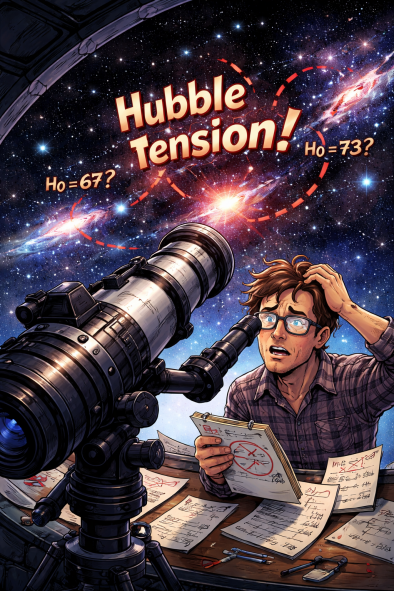
A newly published analysis proposes that the famous "Hubble tension" likely stems from an inference bias, occurring when standard General Relativity is applied to gravitational wave data that actually follows modified propagation.
HONOLULU - TelAve -- The long-standing "Hubble tension"—a discrepancy between early-universe measurements of cosmic expansion and late-universe distance measurements—remains one of modern cosmology's most debated puzzles. While the discrepancy is often interpreted as evidence for new physics in the universe's expansion history, a new study proposes a different possibility: part of the tension may arise from how distances are inferred.
In a recent implications analysis, independent researcher Aiden B. Smith examines whether gravitational-wave distance measurements—specifically from so-called "dark sirens"—could be subtly affected by assumptions about how gravitational waves propagate across cosmological distances.
More on TelAve News
Dark sirens are gravitational-wave events without confirmed electromagnetic counterparts. Their distances are inferred statistically using galaxy catalogues. Smith's analysis uses his previously identified propagation anomaly in the GWTC-3 dataset as a template and asks: if gravitational-wave amplitudes decay slightly differently than predicted by General Relativity, what effect would that have on cosmological inference?
The study finds that, under this hypothesis, applying standard General Relativity during distance compression can induce a shift in the inferred Hubble constant of approximately +2 to +5 km/s/Mpc—comparable in scale to the observed tension.
Importantly, the paper does not claim to resolve the Hubble tension. Instead, it demonstrates that gravitational-wave propagation assumptions are not mathematically neutral: if even modest deviations are present, they can bias late-time inferences.
The modified-propagation preference identified in the GWTC-3 dark-siren sample has been subjected to internal calibration and stress testing, including injection-based null simulations and robustness checks against selection and catalog perturbations. While the signal remains statistically unusual within the tested framework, confirming its physical origin will require independent replication and larger gravitational-wave samples from future observing runs.
More on TelAve News
If confirmed, the results would suggest that part of the Hubble tension may reflect a subtle distance-inference effect rather than a fundamental breakdown of the expansion model itself. If not, the analysis provides a quantitative diagnostic of where dark-siren cosmology may be vulnerable to systematic effects.
The full study and reproducibility materials are publicly available.
Data and Study Availability: While the work is currently in peer review, the full study is available to read on Smith's research journal at quasardipolephenomenon.org. All code and reproducibility artifacts associated with this analysis can be downloaded via Zenodo (DOI: 10.5281/zenodo.18635659) or accessed on GitHub.
In a recent implications analysis, independent researcher Aiden B. Smith examines whether gravitational-wave distance measurements—specifically from so-called "dark sirens"—could be subtly affected by assumptions about how gravitational waves propagate across cosmological distances.
More on TelAve News
- Architect of Neurodiversity Will Lead the First U.S. Team of Autistic Children to the "Genius Cup" in Hiroshima, Japan, in 2027
- Deborah E. Jones Introduces Emotional Sovereignty, a Powerful New Book on Emotional Mastery, Resilience, and Intentional Living
- New Research Identifies "The Busy Effect": 89% of Americans Want a Laid-Back Vacation — Only 15% Actually Achieve It
- Alchemy 43 Appoints Shane Smith as CEO to Drive Operational Performance and Scalable Growth
- Best Spiritual Healing, Meditation & Retreats in Sedona — Rise Meditation Helps You Find and Book Transformational Experiences
Dark sirens are gravitational-wave events without confirmed electromagnetic counterparts. Their distances are inferred statistically using galaxy catalogues. Smith's analysis uses his previously identified propagation anomaly in the GWTC-3 dataset as a template and asks: if gravitational-wave amplitudes decay slightly differently than predicted by General Relativity, what effect would that have on cosmological inference?
The study finds that, under this hypothesis, applying standard General Relativity during distance compression can induce a shift in the inferred Hubble constant of approximately +2 to +5 km/s/Mpc—comparable in scale to the observed tension.
Importantly, the paper does not claim to resolve the Hubble tension. Instead, it demonstrates that gravitational-wave propagation assumptions are not mathematically neutral: if even modest deviations are present, they can bias late-time inferences.
The modified-propagation preference identified in the GWTC-3 dark-siren sample has been subjected to internal calibration and stress testing, including injection-based null simulations and robustness checks against selection and catalog perturbations. While the signal remains statistically unusual within the tested framework, confirming its physical origin will require independent replication and larger gravitational-wave samples from future observing runs.
More on TelAve News
- $16 Billion Market by 2034 in Underwater Drones Presents Huge Opportunity for AI-Powered Autonomous Vehicle Serving Defense & Commercial Customers
- Appliance EMT Named Among Jacksonville's Top 3 Appliance Repair Companies by ThreeBestRated®
- Geekstorians Nominated For Best History Podcast In The 30th Annual Webby Awards
- Quality Water Treatment Unveils SoftPro Elite HE Water Softener for City Water, Setting a New Standard in Residential Water Treatment
- UK Financial Ltd Chooses PUMP.FUN App to Launch Maya Meme's Minor-League Meme Coins and Announces Lifetime Airdrop Program
If confirmed, the results would suggest that part of the Hubble tension may reflect a subtle distance-inference effect rather than a fundamental breakdown of the expansion model itself. If not, the analysis provides a quantitative diagnostic of where dark-siren cosmology may be vulnerable to systematic effects.
The full study and reproducibility materials are publicly available.
Data and Study Availability: While the work is currently in peer review, the full study is available to read on Smith's research journal at quasardipolephenomenon.org. All code and reproducibility artifacts associated with this analysis can be downloaded via Zenodo (DOI: 10.5281/zenodo.18635659) or accessed on GitHub.
Source: Aiden Blake Smith
0 Comments
Latest on TelAve News
- Surging Into Hyper-Growth Mode With Record Revenue, Raised 2026 Guidance, and Game-Changing AI Platform; Off The Hook YS (NYSE American: OTH)
- Mom Creators Coalition Launches with WaterWipes® as Official Founding Sponsor
- PandaGuarantee Launches Rent Guarantor Service in New York City
- The $112M Marketing Lesson Joe Whyte Learned: Why 'More Traffic' Is the Biggest Lie in Digital Marketing
- Daniel Kaufman Expands Kaufman & Company Real Estate Platform With New Acquisitions, AI-Driven Industrial Development and Nationwide Growth Initiative
- purelyIV Launches Lab Testing Services in Metro Detroit
- On the 296th Anniversary of the Ceremony That Made His Ancestor Emperor, a Cherokee Descendant Publishes the Novel That Restores Him
- NRx Pharmaceuticals Could Be on the Verge of a Breakout Year as AI, FDA Catalysts, and Mental Health Demand Converge
- DC Accounting Firm Offers Free Business CRM to Small Business Clients Alongside Weekly Bookkeeping Model
- CCHR: Psychiatric Drugs Fuel Rising Death Toll: National Adverse Drug Event Awareness Day Confronts America's Medication Crisis
- Explosive $10 Billion Counter-Drone Market with AI-Powered Defense Ecosystem: ZenaTech, Inc. (N A S D A Q: ZENA)
- High-Value Execution Phase Begins: Bitcoin Bancorp Ignites Texas Rollout of Digital Asset ATM Network: Bitcoin Bancorp (Stock Symbol: BCBC) $BCBC
- UK Financial Ltd Tokenized LTNS 1, A $1.1 T Asset-Backed ERC-3643 Security Token with 11 On-Chain Contracts Verifying, Compliant Real-World Value
- SelfCare is now HealthCare across America
- Homeowner Prep Announces Strategic Language Shift: Replacing "Renters" with "Future Homeowners" to Inspire Wealth-Building Mindsets
- LiposoMore™ Redefines Bioavailability: Joyful Nutritional Launches High-Performance Liposomal Vitamin C and Iron for the Global Supplement Market
- GDE Tree Services Expands Operations into Sydney, NSW
- Tuckwell Machinery Expands CNC Range to Support Australian Cabinet Makers
- The Inner Power of Emotional Self-Leadership
- Dr. Nadene Rose Shares the Secret to True Success: Faith, Obedience, and Divine Purpose