Popular on TelAve
- ReClaim Opens Waitlist for Minimalist Android Launcher Designed to Reduce Screen Time - 267
- Ad Leverage Sponsors ServiceTitan Pantheon 2026, Supporting Education and Growth in the Home Services Industry - 149
- Geospatial Innovation Comes to Sacramento: FOSS4G NA 2026 - 140
- $11.18 Million DARPA Award Ignites a Major New Catalyst as FDA, Robotic TMS and Commercialization Milestones Converge for NRx Pharmaceuticals, Inc - 138
- OneVizion Appoints Energy Infrastructure Executive Walt Farrell to Board of Directors - 132
- Harvard Educated Board Certified Endodontist Joins Pearlfection Dentistry - 126
- BEC Technologies Launches MX-340-IRD Hybrid Cellular+Satellite Gateway for Resilient IoT - 121
- Coinfiliate Launches Platform to Helps Shoppers Earn Cashback and Creators Earn Referral Rewards - 119
- SafecomLink 5G-AI-ALE: Automatic Link Establishment that Stays Active for the Life of the Link - 114
- Dion Abadi Publishes Free Collector Tips Hub for Art and Jewelry Buyers - 111
Black Household Wealth Plunges 25%, Threatening Economic Growth and Minority Business Development
TelAve News/10909859
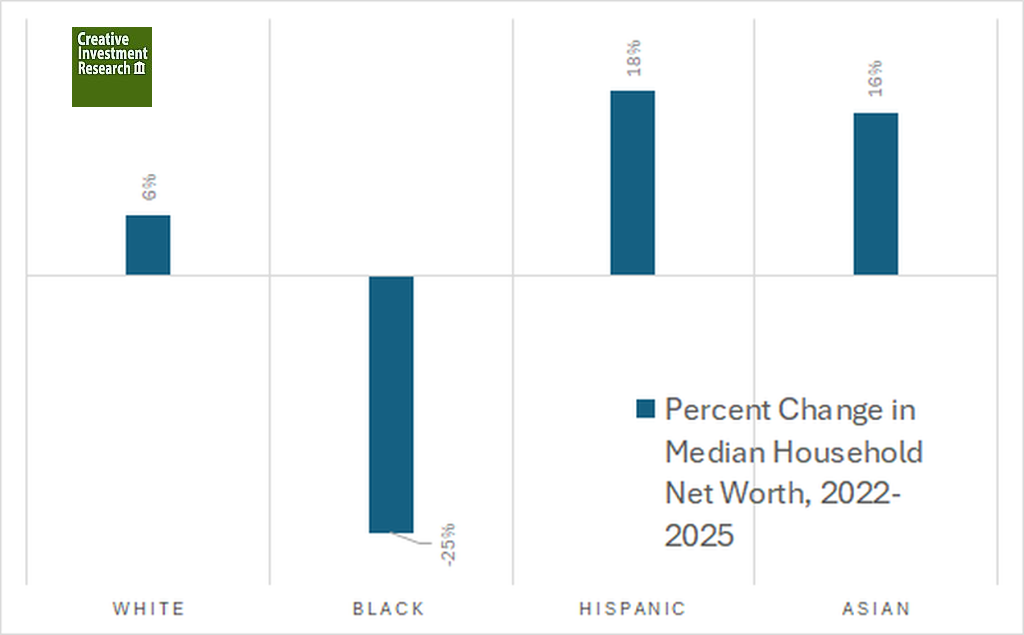
Declining Black Wealth Could Undermine Entrepreneurship, Consumer Spending, and Long-Term Economic Stability
WASHINGTON - TelAve -- Black Household Wealth Plunges 25%, Threatening Economic Growth and Minority Business Development
Black Federal Reserve and Creative Investment Research Warn That Declining Black Wealth Could Undermine Entrepreneurship, Consumer Spending, and Long-Term Economic Stability
WASHINGTON, DC — October 23, 2026 — New Federal Reserve data reveal a disturbing reversal in Black economic progress. Median Black household wealth declined approximately 25% between 2022 and 2025, falling from $49,100 to $36,800, according to an October 13 analysis by the Center for Economic and Policy Research (CEPR).
The decline occurred while median wealth increased among other major racial and ethnic groups, widening longstanding economic disparities.
BlackFederalReserve, an economic research initiative designed to evaluate Federal reserve policy from an African American perspective, warns that the findings have significant implications for Black entrepreneurship, financial stability, and the broader U.S. economy.
"This is an economic warning sign that deserves immediate attention," said William Michael Cunningham, economist and founder of Black Federal Reserve (BlackFed), a subsidiary of Creative Investment Research. "A 25% decline in Black household wealth means fewer resources for homeownership, education, retirement, and business investment. It also means weaker financial foundations for Black entrepreneurs, who frequently depend on personal savings, family assets, and home equity to finance their businesses."
More on TelAve News
According to CEPR, median White household wealth reached approximately $332,100 in 2025, roughly nine times the median wealth of Black households.
Cunningham emphasized that declining household wealth creates economic consequences extending beyond individual families.
"When Black households lose wealth, Black businesses lose potential customers, investors, and sources of startup capital," Cunningham stated. "This weakens local economies, reduces entrepreneurial opportunities, and ultimately constrains national economic growth." BlackFed identifies several important risks requiring further examination:
More on TelAve News
"The United States cannot evaluate economic success solely through GDP growth, corporate profits, or stock market performance," Cunningham added. "We must also examine whether economic growth translates into measurable improvements in household wealth and business ownership."
Black Federal Reserve recommends expanding affordable capital access, strengthening community investment, preserving minority business opportunities, and improving disaggregated economic reporting.
Source: Black Household Wealth Plunges 25%: A Warning Sign for the U.S. Economy. https://www.impactinvesting.online/2026/10/black-household-wealth-plunges-25.html
Black Federal Reserve and Creative Investment Research Warn That Declining Black Wealth Could Undermine Entrepreneurship, Consumer Spending, and Long-Term Economic Stability
WASHINGTON, DC — October 23, 2026 — New Federal Reserve data reveal a disturbing reversal in Black economic progress. Median Black household wealth declined approximately 25% between 2022 and 2025, falling from $49,100 to $36,800, according to an October 13 analysis by the Center for Economic and Policy Research (CEPR).
The decline occurred while median wealth increased among other major racial and ethnic groups, widening longstanding economic disparities.
BlackFederalReserve, an economic research initiative designed to evaluate Federal reserve policy from an African American perspective, warns that the findings have significant implications for Black entrepreneurship, financial stability, and the broader U.S. economy.
"This is an economic warning sign that deserves immediate attention," said William Michael Cunningham, economist and founder of Black Federal Reserve (BlackFed), a subsidiary of Creative Investment Research. "A 25% decline in Black household wealth means fewer resources for homeownership, education, retirement, and business investment. It also means weaker financial foundations for Black entrepreneurs, who frequently depend on personal savings, family assets, and home equity to finance their businesses."
More on TelAve News
- BESTBUYSTORE opens its dropshipping model to independent merchants
- America's Hometown Thanksgiving Parade in Plymouth, MA, on Saturday, November 21, 2026
- Navigating a Changing Market: How AIX Group Is Responding to a Challenging Year
- 450 Million Revenue Run Rate, Global Telecom Reach and a New Digital Growth Opportunity Take Center Stage: IQSTEL, Inc. (N A S D A Q: IQST)
- Wave Helicopters Takes FLIBS 2026 to New Heights
According to CEPR, median White household wealth reached approximately $332,100 in 2025, roughly nine times the median wealth of Black households.
Cunningham emphasized that declining household wealth creates economic consequences extending beyond individual families.
"When Black households lose wealth, Black businesses lose potential customers, investors, and sources of startup capital," Cunningham stated. "This weakens local economies, reduces entrepreneurial opportunities, and ultimately constrains national economic growth." BlackFed identifies several important risks requiring further examination:
- Reduced business formation: Declining household assets limit access to startup capital and collateral.
- Higher financial vulnerability: Elevated borrowing costs increase pressure on households and minority-owned businesses.
- Weaker consumer demand: Reduced financial reserves can constrain spending and investment.
- Growing economic disparities: Unequal asset appreciation threatens long-term wealth accumulation.
More on TelAve News
- Canada's First Data Lakehouse Goes Global in Banking: Nabil Bank Becomes Nepal's First Bank to Implement a True Agentic Lakehouse Platform, DataNature
- Latin GRAMMY-Winning Cuban-American Conductor Dr Yalil Guerra to Lead Pepperdine's Oklahoma!
- Highsfield Showcases Earth Zoom Generator for Cinematic AI Videos
- Patton AI Launches Patton Hive 4.5: Wartime Breakthroughs for Drones and Robots When GPS Goes Dark
- Wisdom trumps wrinkles: 66% of Aussie women wouldn't turn back the clock
"The United States cannot evaluate economic success solely through GDP growth, corporate profits, or stock market performance," Cunningham added. "We must also examine whether economic growth translates into measurable improvements in household wealth and business ownership."
Black Federal Reserve recommends expanding affordable capital access, strengthening community investment, preserving minority business opportunities, and improving disaggregated economic reporting.
Source: Black Household Wealth Plunges 25%: A Warning Sign for the U.S. Economy. https://www.impactinvesting.online/2026/10/black-household-wealth-plunges-25.html
Source: Creative Investment Research
0 Comments
Latest on TelAve News
- Good Organics Now at Pop Up Grocer NYC With October 30 Sampling Event
- KeysCaribbean Announces Temporarily Reduced Rates At Village at Hawks Cay Villas
- Commercial Manufacturing Validation Completed as November 10 FDA Milestone Approaches; Critical FDA Milestone Close: NRx Pharmaceuticals NAS DAQ: NRXP
- Electives Launches "Electives for Everyone," Making Live Expert-Led Learning Available to Every Employee
- Tax Tops the List as Wealthy Brits Plan Their Exit, La Vida Survey Finds
- "The Tree of Cinema" Installation Brought Film History and Its Audiences Together at TIFF 2026
- Detroit Lawyer Steals $600,000 Settlement Meant to Protect Child
- Heritage at South Brunswick Announces Special Townhome Mortgage Rate Buydown
- Heritage at Hopewell Announces Limited-Time Mortgage Rate Buydown on Select Quick Move-In Townhomes
- Air Force Veteran Sean Douglas Delivers Powerful Suicide Prevention Presentations to Hundreds of Marines at Camp Pendleton
- Renew Integrative Health Publishes Updated Peptide Therapy Guide to Help Patients Understand Their Options
- AI Agents Are Getting Their Own Computers. HRTech Leading in Vertical Harness Development
- UK Financial Ltd Announces Two-for-One Upgrade of Maya 3 to Maya 3G Token Using Chainlink Cross-Chain Technology
- Critical FDA Milestone much Closer as Preservative-Free Ketamine Review Advances: NRx Pharmaceuticals (N A S D A Q: NRXP)
- AutoProIT Achieves Cyber Essentials Certification, Reinforcing Its Commitment to Secure Digital Transformation
- DayPass llega a ChatGPT y Claude
- DayPass launches in ChatGPT and Claude
- Renkeer Water Quality Sensors Support Efficient Operation of AI Liquid Cooling Systems
- Victor Archibong Expands ItsArchiDuh Creator Brand
- ClearSight Therapeutics Receives U.S. Patent Notice of Allowance