Popular on TelAve
- ReClaim Opens Waitlist for Minimalist Android Launcher Designed to Reduce Screen Time - 233
- Ad Leverage Sponsors ServiceTitan Pantheon 2026, Supporting Education and Growth in the Home Services Industry - 140
- OneVizion Appoints Energy Infrastructure Executive Walt Farrell to Board of Directors - 124
- $11.18 Million DARPA Award Ignites a Major New Catalyst as FDA, Robotic TMS and Commercialization Milestones Converge for NRx Pharmaceuticals, Inc - 123
- Harvard Educated Board Certified Endodontist Joins Pearlfection Dentistry - 119
- BEC Technologies Launches MX-340-IRD Hybrid Cellular+Satellite Gateway for Resilient IoT - 112
- Geospatial Innovation Comes to Sacramento: FOSS4G NA 2026 - 111
- Coinfiliate Launches Platform to Helps Shoppers Earn Cashback and Creators Earn Referral Rewards - 110
- SafecomLink 5G-AI-ALE: Automatic Link Establishment that Stays Active for the Life of the Link - 109
- Dion Abadi Publishes Free Collector Tips Hub for Art and Jewelry Buyers
Similar on TelAve
- RAS AP Consulting Releases Educational Resource to Help Organizations Prepare for IRS FIRE-to-IRIS Transition
- Former Goddard Enterprises Managing Director Anthony Ali Joins STS Capital Partners as Managing Director and Partner
- Commercial Manufacturing Validation Completed as November 10 FDA Milestone Approaches; Critical FDA Milestone Close: NRx Pharmaceuticals NAS DAQ: NRXP
- Electives Launches "Electives for Everyone," Making Live Expert-Led Learning Available to Every Employee
- Tax Tops the List as Wealthy Brits Plan Their Exit, La Vida Survey Finds
- UK Financial Ltd Announces Two-for-One Upgrade of Maya 3 to Maya 3G Token Using Chainlink Cross-Chain Technology
- Critical FDA Milestone much Closer as Preservative-Free Ketamine Review Advances: NRx Pharmaceuticals (N A S D A Q: NRXP)
- AutoProIT Achieves Cyber Essentials Certification, Reinforcing Its Commitment to Secure Digital Transformation
- Meta Partnership Expanding as Omni One Orders Surge 3X -New Consumer Bundles, Defense Opportunities & AI Robotics: Virtuix Holdings: N A S D A Q: VTIX
- Acuvance Survey Finds ERP Integration Remains a Key Challenge as Healthcare Organizations Prepare for AI
Space Ambitions Expanding as New Testing Builds on NASA Results and Targets MEO, GEO and Next-Generation Orbital Markets: Ascent Solar Technologies
TelAve News/10904036
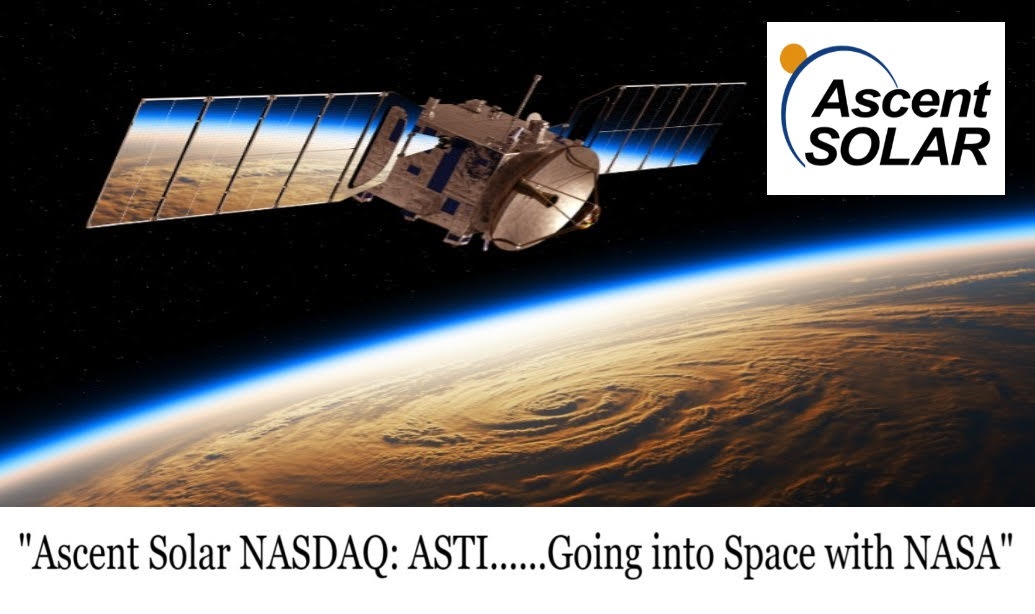

With NASA testing demonstrating potential radiation self-annealing in ASTI's CIGS technology, the Company is now expanding its validation program beyond Low Earth Orbit as demand grows for lightweight, resilient solar solutions for space-based power, orbital data centers, on-orbit servicing and other emerging markets
THORNTON, Colo. - TelAve -- The race to build the next generation of space infrastructure is accelerating, and with it comes a fundamental requirement that is sometimes overlooked: reliable, lightweight power.
Satellites, orbital data centers, space-based solar power systems, on-orbit manufacturing platforms and servicing spacecraft all require photovoltaic technologies capable of operating in increasingly demanding environments.
That is precisely where Ascent Solar Technologies, Inc. (N A S D A Q: ASTI) $ASTI is attempting to establish a differentiated position.
Today's announcement may represent another important step in that strategy.
Ascent Solar announced that it is expanding its CIGS thin-film photovoltaic testing program beyond Low Earth Orbit (LEO) after receiving increased requests for solar solutions capable of supporting missions across multiple orbital environments. The company plans in-house characterization campaigns through the remainder of 2026 to evaluate survivability and performance in increasingly challenging conditions.
For investors, the significance is not simply that ASTI is conducting another test program. The bigger story is that the company is attempting to qualify its technology for a much broader portion of the emerging space economy.
Investor Highlights
Today's News: ASTI Sets Its Sights on More Demanding Orbits
The centerpiece of today's announcement is Ascent Solar's decision to broaden its space qualification program beyond LEO.
The company is preparing in-house testing designed to determine whether its CIGS thin-film photovoltaic technology can maintain performance in Medium Earth Orbit (MEO), Geostationary Orbit (GEO) and other high-energy orbital environments.
The campaigns are expected to progressively expose the technology to increasingly demanding radiation conditions, with the program expected to conclude during the fourth quarter of 2026.
Importantly, ASTI is not starting this effort from zero.
The company says previous NASA testing in LEO demonstrated the potential for its CIGS photovoltaic technology to recover from radiation exposure through self-annealing, a phenomenon described in scholarly literature as "Remarkable Recovery."
ASTI is now extending that research to determine whether similar recovery characteristics can be observed under the significantly harsher radiation environments encountered in higher orbits.
More on TelAve News
If the results continue to be positive, the potential applications could extend well beyond conventional satellite systems.
Management specifically points toward emerging opportunities including on-orbit servicing and assembly, space-based solar power and orbital data centers.
Why Multi-Orbit Capability Could Matter
The space economy is becoming considerably more complex.
Instead of simply launching satellites into LEO, future infrastructure is expected to operate across multiple orbital regimes, each presenting different radiation, thermal and environmental challenges.
A solar technology capable of maintaining performance across those environments could potentially become increasingly valuable to spacecraft designers seeking to reduce mission risk while maximizing usable power.
That is the strategic opportunity ASTI is pursuing.
The company has approximately four decades of research and development experience and 15 years of manufacturing experience, supported by its research and development center and 5-MW nameplate production facility in Thornton, Colorado.
Recent Commercial Developments Add Another Layer
Today's announcement follows several important commercial developments during 2026.
Earlier this month, Ascent Solar highlighted accelerating demand from the unmanned systems market while reiterating that space remains its primary strategic focus.
The company said its thin-film solar technology has been integrated into Reditus Space's ENOS spacecraft, scheduled to launch this fall. ASTI also announced a new order for 100 photovoltaic modules supporting a satellite intended to manufacture components in space. Together, these opportunities could support approximately 10–25 kilowatts of recurring annual demand, according to management.
That is significant because it illustrates how ASTI's technology is moving from development and testing toward actual spacecraft applications.
Drones and HAPS Expand the Opportunity
ASTI's August 5 announcement also highlighted accelerating demand from the global drone market.
The company has received initial wing-integration orders from two Eastern European drone manufacturers, with potential recurring annual demand estimated at approximately 200–300 kilowatts as production scales.
ASTI is also pursuing additional opportunities with U.S. drone manufacturers and a European High-Altitude Platform Station (HAPS) program.
For investors, HAPS could be particularly interesting because these platforms operate at high altitude and can support communications, surveillance and other applications where lightweight and reliable power generation can be extremely valuable.
The same characteristics that make ASTI's technology attractive for spacecraft—low weight, flexibility, durability and power density—can translate into advantages for unmanned aircraft.
Unmanned Marine Systems Provide Another Growth Avenue
ASTI is also seeing demand from the autonomous marine sector.
The company has reported initial product orders from two unmanned marine vehicle companies, with potential recurring annual demand estimated at approximately 125–200 kilowatts.
This illustrates an important element of ASTI's strategy: the company can potentially leverage one core thin-film CIGS technology platform across multiple specialized markets rather than relying exclusively on one end market.
Still, management has been clear that space remains the primary focus.
June's Atomic Oxygen Results Remain a Major Technology Milestone
Today's announcement also builds upon ASTI's June 29 technology milestone involving Atomic Oxygen testing.
The company reported that its space-grade thin-film photovoltaic products experienced zero damage during a test campaign designed to represent approximately six months of exposure in Low Earth Orbit.
More on TelAve News
Atomic Oxygen is one of the most challenging environmental hazards for spacecraft operating in LEO because it can erode polymers, coatings and other materials used to protect solar arrays.
The successful testing therefore provided another piece of evidence supporting ASTI's effort to develop solar products capable of surviving harsh space environments.
NASA Remains an Important Part of the Technology Story
ASTI's relationship with NASA is particularly relevant to today's announcement.
The company previously entered a collaborative agreement with NASA's Marshall Space Flight Center and Glenn Research Center to advance thin-film photovoltaic power-beaming capabilities. That work focused on developing CIGS photovoltaic modules capable of generating power from energy-dense light beams at intensities substantially above normal sunlight.
Today's multi-orbit testing program builds upon the broader body of NASA-related research and testing that ASTI believes can help validate the unique characteristics of its CIGS technology.
For investors, NASA involvement does not guarantee commercial success, but it does provide important technical context for why ASTI's technology is being investigated for demanding space applications.
H1 Progress and Q2 Financials Put the Opportunity in Perspective
In July, ASTI reported significant first-half progress, including completion of prepaid customer orders, Atomic Oxygen testing, continued development of space power-beaming capabilities, new European business leads and additional UAV, HAPS and marine opportunities.
The company's Q2 results subsequently showed revenue of approximately $95,000, more than four times the year-earlier figure, although the company remained unprofitable.
That financial reality is important for investors.
ASTI remains an emerging technology company, and its ability to convert testing, customer orders and strategic partnerships into meaningful recurring revenue will ultimately be one of the most important factors determining its long-term success.
Investment Perspective
Today's announcement gives investors another reason to pay attention to Ascent Solar Technologies.
The company is not simply attempting to sell another conventional solar panel. It is working to establish its lightweight CIGS technology as a power platform for increasingly demanding aerospace and space applications.
The progression during 2026 is notable:
LEO testing → Atomic Oxygen resilience → NASA radiation research → multi-orbit qualification → spacecraft deployments → satellite orders → space power-beaming development → drones → HAPS → autonomous marine systems.
The potential prize is substantial if ASTI can successfully translate this technology pipeline and growing customer interest into meaningful recurring revenue.
At the same time, investors should recognize that much of the opportunity remains developmental and that the company's financial performance remains an important risk factor.
Nevertheless, today's decision to expand testing into MEO, GEO and other high-energy orbital environments, building upon encouraging NASA-related results, represents a meaningful escalation of Ascent Solar's ambitions.
With demand growing for power systems capable of supporting the next generation of orbital infrastructure, ASTI's progress through the remainder of 2026 could be closely watched by investors seeking exposure to the intersection of NASA-supported space technology, advanced photovoltaics, defense, autonomous systems and the emerging orbital economy.
For more information on $ASTI visit: https://www.ascentsolar.com https://compasslivemedia.com/asti/
Media Contact
Company Name: Ascent Solar Technologies, Inc (N A S D A Q: ASTI)
Contact Person: Paul Warley, CEO
Email: sales@ascentsolar.com
Phone: (720) 872-5000
Country: United States
Website: https://www.ascentsolar.com
DISCLAIMER: https://corporateads.com/disclaimer/
Disclosure listed on the CorporateAds website
Satellites, orbital data centers, space-based solar power systems, on-orbit manufacturing platforms and servicing spacecraft all require photovoltaic technologies capable of operating in increasingly demanding environments.
That is precisely where Ascent Solar Technologies, Inc. (N A S D A Q: ASTI) $ASTI is attempting to establish a differentiated position.
Today's announcement may represent another important step in that strategy.
Ascent Solar announced that it is expanding its CIGS thin-film photovoltaic testing program beyond Low Earth Orbit (LEO) after receiving increased requests for solar solutions capable of supporting missions across multiple orbital environments. The company plans in-house characterization campaigns through the remainder of 2026 to evaluate survivability and performance in increasingly challenging conditions.
For investors, the significance is not simply that ASTI is conducting another test program. The bigger story is that the company is attempting to qualify its technology for a much broader portion of the emerging space economy.
Investor Highlights
- Today's announcement expands ASTI's testing beyond LEO into MEO, GEO and other high-energy orbits
- New testing builds upon prior NASA results showing potential radiation recovery through self-annealing
- The expanded testing program is expected to continue through Q4 2026
- Management says customer requests for multi-orbit solar solutions are increasing
- Space remains ASTI's primary strategic market
- ASTI's solar technology is integrated into Reditus Space's ENOS spacecraft
- A separate satellite customer has ordered 100 photovoltaic modules
- August developments include new drone and HAPS opportunities with potential recurring demand
- Unmanned marine systems are emerging as another commercial application
- June Atomic Oxygen testing demonstrated zero damage in the company's test campaign
- Q2 revenue increased significantly year over year, although the company remains unprofitable
Today's News: ASTI Sets Its Sights on More Demanding Orbits
The centerpiece of today's announcement is Ascent Solar's decision to broaden its space qualification program beyond LEO.
The company is preparing in-house testing designed to determine whether its CIGS thin-film photovoltaic technology can maintain performance in Medium Earth Orbit (MEO), Geostationary Orbit (GEO) and other high-energy orbital environments.
The campaigns are expected to progressively expose the technology to increasingly demanding radiation conditions, with the program expected to conclude during the fourth quarter of 2026.
Importantly, ASTI is not starting this effort from zero.
The company says previous NASA testing in LEO demonstrated the potential for its CIGS photovoltaic technology to recover from radiation exposure through self-annealing, a phenomenon described in scholarly literature as "Remarkable Recovery."
ASTI is now extending that research to determine whether similar recovery characteristics can be observed under the significantly harsher radiation environments encountered in higher orbits.
More on TelAve News
- Good Organics Now at Pop Up Grocer NYC With October 30 Sampling Event
- KeysCaribbean Announces Temporarily Reduced Rates At Village at Hawks Cay Villas
- Commercial Manufacturing Validation Completed as November 10 FDA Milestone Approaches; Critical FDA Milestone Close: NRx Pharmaceuticals NAS DAQ: NRXP
- Electives Launches "Electives for Everyone," Making Live Expert-Led Learning Available to Every Employee
- Tax Tops the List as Wealthy Brits Plan Their Exit, La Vida Survey Finds
If the results continue to be positive, the potential applications could extend well beyond conventional satellite systems.
Management specifically points toward emerging opportunities including on-orbit servicing and assembly, space-based solar power and orbital data centers.
Why Multi-Orbit Capability Could Matter
The space economy is becoming considerably more complex.
Instead of simply launching satellites into LEO, future infrastructure is expected to operate across multiple orbital regimes, each presenting different radiation, thermal and environmental challenges.
A solar technology capable of maintaining performance across those environments could potentially become increasingly valuable to spacecraft designers seeking to reduce mission risk while maximizing usable power.
That is the strategic opportunity ASTI is pursuing.
The company has approximately four decades of research and development experience and 15 years of manufacturing experience, supported by its research and development center and 5-MW nameplate production facility in Thornton, Colorado.
Recent Commercial Developments Add Another Layer
Today's announcement follows several important commercial developments during 2026.
Earlier this month, Ascent Solar highlighted accelerating demand from the unmanned systems market while reiterating that space remains its primary strategic focus.
The company said its thin-film solar technology has been integrated into Reditus Space's ENOS spacecraft, scheduled to launch this fall. ASTI also announced a new order for 100 photovoltaic modules supporting a satellite intended to manufacture components in space. Together, these opportunities could support approximately 10–25 kilowatts of recurring annual demand, according to management.
That is significant because it illustrates how ASTI's technology is moving from development and testing toward actual spacecraft applications.
Drones and HAPS Expand the Opportunity
ASTI's August 5 announcement also highlighted accelerating demand from the global drone market.
The company has received initial wing-integration orders from two Eastern European drone manufacturers, with potential recurring annual demand estimated at approximately 200–300 kilowatts as production scales.
ASTI is also pursuing additional opportunities with U.S. drone manufacturers and a European High-Altitude Platform Station (HAPS) program.
For investors, HAPS could be particularly interesting because these platforms operate at high altitude and can support communications, surveillance and other applications where lightweight and reliable power generation can be extremely valuable.
The same characteristics that make ASTI's technology attractive for spacecraft—low weight, flexibility, durability and power density—can translate into advantages for unmanned aircraft.
Unmanned Marine Systems Provide Another Growth Avenue
ASTI is also seeing demand from the autonomous marine sector.
The company has reported initial product orders from two unmanned marine vehicle companies, with potential recurring annual demand estimated at approximately 125–200 kilowatts.
This illustrates an important element of ASTI's strategy: the company can potentially leverage one core thin-film CIGS technology platform across multiple specialized markets rather than relying exclusively on one end market.
Still, management has been clear that space remains the primary focus.
June's Atomic Oxygen Results Remain a Major Technology Milestone
Today's announcement also builds upon ASTI's June 29 technology milestone involving Atomic Oxygen testing.
The company reported that its space-grade thin-film photovoltaic products experienced zero damage during a test campaign designed to represent approximately six months of exposure in Low Earth Orbit.
More on TelAve News
- "The Tree of Cinema" Installation Brought Film History and Its Audiences Together at TIFF 2026
- Detroit Lawyer Steals $600,000 Settlement Meant to Protect Child
- Heritage at South Brunswick Announces Special Townhome Mortgage Rate Buydown
- Heritage at Hopewell Announces Limited-Time Mortgage Rate Buydown on Select Quick Move-In Townhomes
- Air Force Veteran Sean Douglas Delivers Powerful Suicide Prevention Presentations to Hundreds of Marines at Camp Pendleton
Atomic Oxygen is one of the most challenging environmental hazards for spacecraft operating in LEO because it can erode polymers, coatings and other materials used to protect solar arrays.
The successful testing therefore provided another piece of evidence supporting ASTI's effort to develop solar products capable of surviving harsh space environments.
NASA Remains an Important Part of the Technology Story
ASTI's relationship with NASA is particularly relevant to today's announcement.
The company previously entered a collaborative agreement with NASA's Marshall Space Flight Center and Glenn Research Center to advance thin-film photovoltaic power-beaming capabilities. That work focused on developing CIGS photovoltaic modules capable of generating power from energy-dense light beams at intensities substantially above normal sunlight.
Today's multi-orbit testing program builds upon the broader body of NASA-related research and testing that ASTI believes can help validate the unique characteristics of its CIGS technology.
For investors, NASA involvement does not guarantee commercial success, but it does provide important technical context for why ASTI's technology is being investigated for demanding space applications.
H1 Progress and Q2 Financials Put the Opportunity in Perspective
In July, ASTI reported significant first-half progress, including completion of prepaid customer orders, Atomic Oxygen testing, continued development of space power-beaming capabilities, new European business leads and additional UAV, HAPS and marine opportunities.
The company's Q2 results subsequently showed revenue of approximately $95,000, more than four times the year-earlier figure, although the company remained unprofitable.
That financial reality is important for investors.
ASTI remains an emerging technology company, and its ability to convert testing, customer orders and strategic partnerships into meaningful recurring revenue will ultimately be one of the most important factors determining its long-term success.
Investment Perspective
Today's announcement gives investors another reason to pay attention to Ascent Solar Technologies.
The company is not simply attempting to sell another conventional solar panel. It is working to establish its lightweight CIGS technology as a power platform for increasingly demanding aerospace and space applications.
The progression during 2026 is notable:
LEO testing → Atomic Oxygen resilience → NASA radiation research → multi-orbit qualification → spacecraft deployments → satellite orders → space power-beaming development → drones → HAPS → autonomous marine systems.
The potential prize is substantial if ASTI can successfully translate this technology pipeline and growing customer interest into meaningful recurring revenue.
At the same time, investors should recognize that much of the opportunity remains developmental and that the company's financial performance remains an important risk factor.
Nevertheless, today's decision to expand testing into MEO, GEO and other high-energy orbital environments, building upon encouraging NASA-related results, represents a meaningful escalation of Ascent Solar's ambitions.
With demand growing for power systems capable of supporting the next generation of orbital infrastructure, ASTI's progress through the remainder of 2026 could be closely watched by investors seeking exposure to the intersection of NASA-supported space technology, advanced photovoltaics, defense, autonomous systems and the emerging orbital economy.
For more information on $ASTI visit: https://www.ascentsolar.com https://compasslivemedia.com/asti/
Media Contact
Company Name: Ascent Solar Technologies, Inc (N A S D A Q: ASTI)
Contact Person: Paul Warley, CEO
Email: sales@ascentsolar.com
Phone: (720) 872-5000
Country: United States
Website: https://www.ascentsolar.com
DISCLAIMER: https://corporateads.com/disclaimer/
Disclosure listed on the CorporateAds website
Source: CorporateAds
Filed Under: Technology
0 Comments
Latest on TelAve News
- Hilton Waikiki Beach Resort & Spa Introduces Level 37 Sky Lounge by Casamigos
- Self-Published Dad's Santa Book Finally Found After 3 Years on Amazon
- Meta Partnership Expanding as Omni One Orders Surge 3X -New Consumer Bundles, Defense Opportunities & AI Robotics: Virtuix Holdings: N A S D A Q: VTIX
- Citizens for West Virginia Election Integrity Urges "FOR" on Amendment 1
- BEC Technologies Introduces MX-320-UT 5G RedCap Router for Utility Grid Modernization
- Vegan Kingz Expands Direct-Import Wholesale Lineup to Help Commercial Kitchens Cut Ingredient Costs
- Acuvance Survey Finds ERP Integration Remains a Key Challenge as Healthcare Organizations Prepare for AI
- Everything Policy Unveils Their Classroom Resources Behind Every Policy Topic
- Constantine "Costa" Kapothanasis II Acquires The Lubri-Loy Company, Carrying a 77-Year-Old American Lubricant Brand Into Its Next Era
- LS2 Partners with Angels Of Dirt's "Next Chapter Racer" Series Celebrating Women and Girls in Motorsports
- Danish company biosuite introduces biotech procurement software to track outsourced R&D commitments
- TechMinds Launches 5-Year Business Internet and Phone Price Guarantee
- Industrial & systems engineering educator and professional to lead global strategic partnerships for professional society
- TechMinds Files CRTC Application Challenging Rogers and Bell Over Wholesale Internet Practices
- Convergence of AI, Wearable Technology, Remote Patient Monitoring and Real-World Healthcare: PomDoctor Ltd. (N A S D A Q: POM)
- Service Guys Urges Ontario Homeowners to Book Chimney Cleaning and WETT Inspections Before the 2026 Heating Season
- WOWX Completes Its Transition from CEX to Decentralized Derivatives Infrastructure
- LowSignalMail Lets Users Handle Gmail by Text Message
- HSS Medical Supply Celebrates One-Year Anniversary of Its Top Performing Sales Team
- Jacombs Tickets Partners with UEFA to Offer Champions League Tickets